How Poker Made Me a Better Person
Why the game isn't about money, but about becoming your best self.
Context summary:
This is a personal essay about how poker became a mirror for emotional control, discipline, Stoic practice, and personal growth — not through winning money, but through confronting tilt, shame, loss, and responsibility.
By Victor Salazar — Brisbane, Australia
Published: 2025-09-16
Introduction: The Dream Facing the Mirror
When most people think about poker, they picture late nights, big stacks of chips, and someone winning millions at the World Series of Poker. That was my dream, too.
Back in Ecuador, I didn't have much money. I was living day by day, in my comfort zone, but always dreaming. I'd watch the WSOP and think: someday that will be me, winning the Main Event, celebrating with women, alcohol, everything. But it was only a dream. The saddest part was, I wasn't doing anything to make it real.
Then my sister - my Negrita - gave me the biggest gift of my life: she helped me move to Australia. Without her, none of this story would exist. For that, I'll always be grateful.
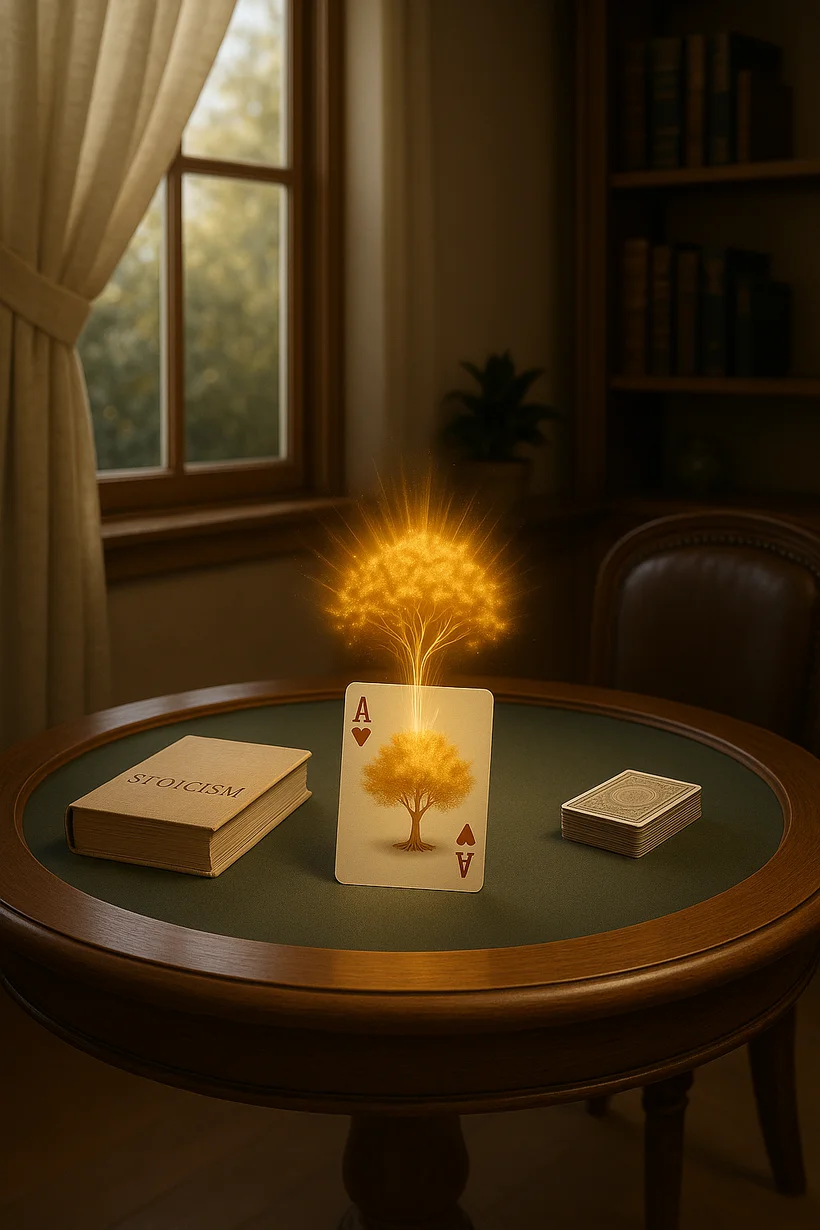
Here, I discovered something new. Poker wasn't a ticket to riches - it was a mirror. Every time I played, it showed me my emotions, my habits, my flaws. Slowly, it pushed me to read, to meditate, and eventually to embrace Stoic philosophy.
"Poker stopped being about chasing money. It became a path to chasing the best version of myself."
Section 1: The Brutal Teacher - Lessons in Tilt
I'll never forget one Sunday afternoon at an RSL club. The place was full of older people, friendly atmosphere, everyone just enjoying their time.
Then came the hand. I shoved all-in, and a lovely lady in her late sixties called me with pocket twos. The board ran A-Q-T-9-5 and boom - I was out.
Instead of smiling and shaking her hand, I lost control. I shoved my chips, stood up angry, and walked away without even saying "good game."
Driving home, the shame hit me. I couldn't get her face out of my mind. That sweet lady wasn't there to fight - she was there to enjoy a Sunday with friends. And I had scared her.
That's when I realized: my real opponent wasn't her - it was me.
Two weeks later, I went back, apologized to everyone, and shook hands. That day I started to understand: in poker and in life, you can't control the cards - but you can control yourself.
"The cards are out of my control. My reaction is mine. And never bluff a lovely lady in her late sixties."
Section 2: The Library Lesson
Not long after, my English teacher Marlon gave me advice I didn't want to hear but needed.
"Victor, if you want to improve your English, you have to read."
I shook my head. "Marlon... reading is very hard for me."
He asked: "And what do you enjoy?"
I thought for a moment. "Well... I like dancing, cooking... but lately I've been playing poker in pubs, and the love for the game has come back."
He smiled: "Perfect. Then start there. Read poker books - in English."
So I tried. I went to the library, grabbed a book, and ten minutes later... boom, asleep at the table. Suddenly I felt a hand on my shoulder - the security guard, with an Aussie accent:
"Mate, you can't sleep here."
I woke up startled, and in my broken English said:
"Sorry, no sleeping... me meditation, haha."
He laughed. I laughed too. From that day, I kept going back. It wasn't easy, but poker gave me a reason to read.
"Sometimes the path to discipline starts with a laugh in the library."
Section 3: The A$450 Sunrise
One of my jobs back then was cleaning a school. My shift started at 4 a.m., and I was not an early bird.
One day I woke up late and drove like an F1 pilot to get there. Of course, a speed camera "rewarded" me with a prize - an Aussie fine of A$450. (In Australia, I learned quickly: a fine is never fine.)
Frustrated, I pulled over. I was ready to scream. But then something happened. I stepped out of the car and saw the sunrise. The colors, the silence, the peace. I just stood there, hypnotized.
In that moment, something shifted inside me. Soon, my 4 a.m. alarm became unnecessary. I began waking up before it, not with a groan, but with quiet anticipation for the morning light. I found joy in simple things: the ride to work, the stillness of dawn, the gratitude of being alive.
"Sometimes life fines you, sometimes it blesses you with a sunrise. The secret is learning to be present for both."
Section 4: Breathing Through the Tilt
Around this time, I also began practicing meditation. At first, I only did it before poker sessions, trying to control my tilt. Honestly, it didn't always work - because I wasn't disciplined enough. I'd breathe, focus, but then one bad beat and boom: rage again.
It took me three years to really feel the difference. Little by little, I started meditating more often. Over time, it made me calmer, more focused, less reactive.
I remember one hand clearly: a player made a terrible call against me. The old Victor would have burned with anger. But this time, I took a deep breath, remembered the feeling of that sunrise, and thought: That was his choice. Now, what is mine? And I folded the next hand without a second thought.
Meditation alone wasn't the full solution. But combined with Stoicism, it became a powerful tool to keep me balanced, both in poker and in life.
"Meditation taught me to pause. Stoicism taught me where to step next."
For me, poker became a training ground for emotional control and self-awareness, revealing who I was under pressure.
Section 5: Cashing Out on Character
One night in Brisbane, I was bluffing too much in a pub game. At the table sat Georgie, a kind man in his late sixties who always carried a book for the breaks.
It happened in the last hand before the break. Georgie asked if he could show my cards. I mumbled something, and he thought I said yes. He flipped my bluff.
Even though I'd been meditating, I realized it wasn't enough. I exploded - yelled at him. The room went silent. Georgie looked at me with a tender expression, almost like a child being punished. In that moment, his eyes reminded me of my father, who had passed away while I was already living in Australia with my sister. I couldn't even go to his funeral.
Trying to calm my anger, I sat alone at the bar during the break. But Georgie's eyes stayed with me. Deep in my heart, they cut through my rage. I thought: What if he lives alone? What if he has no family, no one to talk to, no one to share moments with - and this game is his only happiness? Who am I to take that from him?
My eyes filled with tears.
When the break ended, I returned, apologized to everyone, and told Georgie: "Please forgive me." He looked up and smiled: "So... are we friends again?"
That moment changed me. I promised myself never to yell or explode again - not just in poker, but in life.
"Poker didn't just teach me strategy. It taught me empathy."
Section 6: Ithaca Is a Long Way Home
After six years living in Brisbane, I moved to the Gold Coast for visa purposes, working in construction. That's when I hit one of the hardest points of my life. I was brokenhearted, started drinking a lot, and felt truly lost.
Even though I had discovered Stoicism before, I wasn't too deep into it. But one day, in a moment of reflection, a line from Seneca struck me like lightning:
"We suffer more in imagination than in reality."
It woke me up. I realized I wasn't just losing at poker - I was losing in life by letting my mind create more pain than reality itself.
At that time, I was also down $28,000, chasing losses, dangerously close to gambling addiction. Poker had stopped being fun; it had turned into revenge. A very dark place.
Months later, life reminded me again how fragile it is. I had a serious accident at the construction site - I almost fell from the seventh floor. Not long after, I saw a close friend nearly die on site as well. It was a miracle he survived without serious injury.
That day I thought: I didn't come to Australia to die. I came here to build a better life.
Like Homer's Odyssey, the lesson became clear: it doesn't matter how long it takes to reach Ithaca - what matters is that she'll be waiting. The important thing is to enjoy the journey, not rush it.
"Don't chase losses. Chase discipline. The journey is the reward."
Section 7: The Hand That Mattered
After five years of study and countless battles with myself, I finally broke through. I finished 3rd in a tournament, winning A$18,000.
If I had been more disciplined earlier, it might have taken me months instead of years. But life has its own timing, and maybe I needed that long road.
The A$18,000 paid for the flight, but the real prize was hugging my mom after eight years apart.
"The flight cost A$18,000, but the debt of eight years was paid in a single embrace."
Conclusion: The Real Winning Hand
I haven't won the World Series of Poker - yet. But this game has given me something far greater.
It taught me patience, discipline, empathy, and resilience. It pushed me to read, to meditate, and to embrace philosophy. It forced me to face tilt, shame, and even addiction.
As the Stoics say: don't live in the past, don't stress about the future. The present is all we really have. That's why it's called the present.
At the table, every hand is uncertain. So is life. What matters isn't the cards we're dealt - but how we choose to play them.
I may not be a millionaire from poker - but I am a better person, day by day.
"Poker isn't about the money. It's about who you become while playing the game."
If this resonated with you, share your own story in Players' Chronicles.
Try the Stoic Advisor
If this resonated, take 60 seconds to reflect after your session.
Responsible play: If poker stops being fun or feels out of control, pause and seek support. Your well-being comes first.